Imagine being told, at the age of 74, that despite having suffered a complete rotator cuff tear — the kind of injury that many surgeons would operate on without hesitation — you could still lift a 10-pound weight overhead 150 times in a row, play tennis with a hard serve, pull a 60-pound archery bow, and dig ditches.
No surgery. No cortisone injections. No months of post-operative rehabilitation.
Just a bar. Some light weights. And a willingness to hang.
That’s Dr John Kirsch’s story — an American orthopaedic surgeon who developed severe shoulder impingement in both shoulders in the early 1980s, stumbled upon the therapeutic potential of bar hanging by accident, spent nearly three decades researching it, and eventually suffered a complete supraspinatus tear at 74 that he rehabbed — entirely — using the protocol he’d spent his career refining.
His book, Shoulder Pain? The Solution & Prevention, is one of the most practically useful things written about shoulder health in the past 50 years. It’s also one of the least known.
This post is our attempt to change that — particularly for people in Preston, Thornbury, and across Melbourne’s northern suburbs who are living with shoulder pain and don’t know there’s a structured, evidence-based, non-surgical path available to them.
The One Thing Your Shoulder Was Designed to Do That Modern Life Prevents
Here’s a thought experiment.
Think about how many times in the last month your arm has been fully overhead — not just raised to shoulder height, but reaching up to full extension, bearing weight, with your whole body working against gravity from that overhead position. If you’re an office worker, a driver, or someone who spends most of their time in front of screens, the honest answer is probably close to zero.
Now think about how many times per day our primate ancestors performed that exact movement. Our evolutionary cousins — chimpanzees, gibbons, orang-utans — spend a significant portion of their daily lives brachiating: moving hand-over-hand through trees, hanging, climbing, reaching. Their shoulders are extraordinarily healthy as a result. Rotator cuff tears and subacromial impingement — two of the most common musculoskeletal diagnoses in modern humans — are essentially unknown in wild primates.
This is not a coincidence.
Kirsch’s central thesis is that the coracoacromial arch — the bony and ligamentous roof that sits over the rotator cuff — is maintained in its proper shape by the regular overhead loading that brachiating produces. When the arm is raised fully and body weight hangs from it, the dense bone of the humeral head presses against the underside of the arch, gradually reshaping it to maintain adequate subacromial space.
When we stop hanging — as modern humans almost entirely have — the arch gradually tightens and loses its normal shape. The space beneath it narrows. The rotator cuff gets pinched. Pain follows.
What Kirsch’s Research Actually Found
Between 1980 and 2012, Kirsch gathered data on 92 patients who used his hanging and weight lifting protocol to address their shoulder pain. He presented this data formally at the 1st Combined Australian/American meeting of hand and upper extremity surgery societies in Kauai, Hawaii — the first formal academic study of the hanging exercise for shoulder rehabilitation.
The patient cohort included:
- 70 people with subacromial impingement syndrome (SIS) — the most common cause of shoulder pain
- 16 people with MRI-confirmed rotator cuff tears
- 4 people with frozen shoulder (adhesive capsulitis)
- 2 people with glenohumeral osteoarthritis accompanied by severe impingement
Of these 92 patients — many of whom had been suffering for years, had tried multiple other treatments without success, and were already scheduled for surgery — 90 returned to comfortable activities of daily living and remained so at long-term follow-up periods ranging from one to 28 years.
Two patients with severe shoulder pain had been scheduled for total shoulder replacement surgery. Both cancelled.
Two patients discontinued for personal reasons unrelated to the protocol.
The one patient who deserves special mention is a 70-year-old woman with confirmed glenohumeral osteoarthritis. She was scheduled for total shoulder resurfacing — a major surgery. Kirsch evaluated her and identified that while the OA was real, the primary driver of her pain was severe subacromial impingement, not the arthritic joint itself. She began the hanging and weight lifting protocol. She cancelled her surgery. One year later she was completely pain-free and had returned to cross-country skiing. Five years after that, she could shift a manual transmission car — something she’d lost the ability to do during the years of untreated impingement.
These are not anecdotes. They are documented outcomes from a formal academic study — and they represent an approach that remains dramatically underutilised in Australian clinical practice.
The Mechanism: Why Hanging Actually Works
To understand why hanging works, you have to understand what happens mechanically when you take an overhead position.
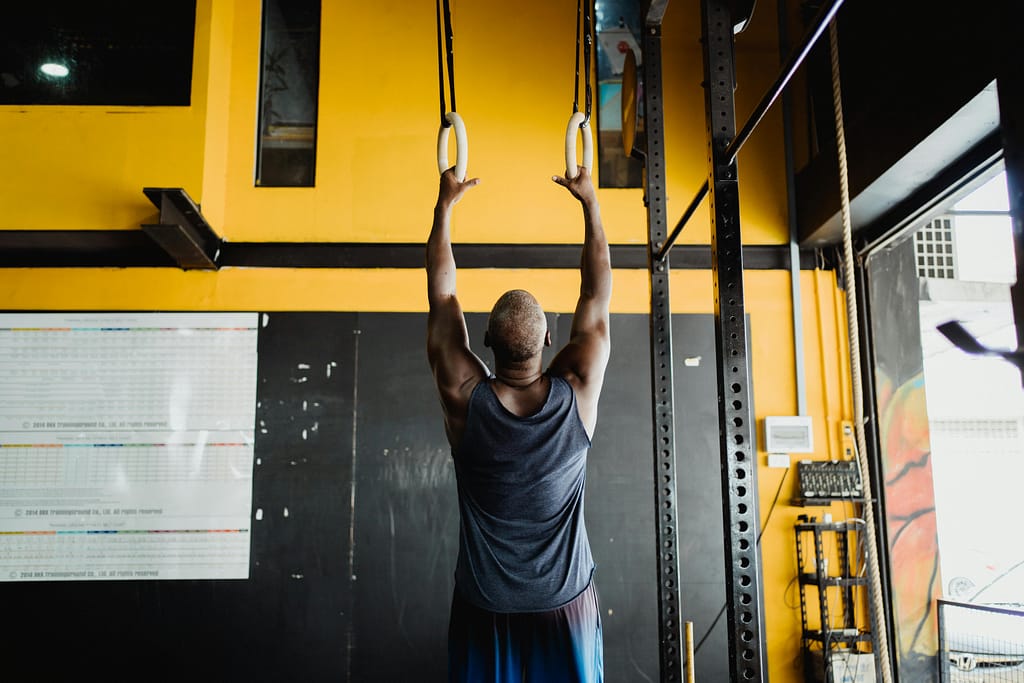
When the arm is elevated and the body hangs from it, the head of the humerus moves to a position that presses firmly against the underside of the coracoacromial arch. The body’s weight creates a sustained, directional loading force on the arch — bending it, stretching the coracoacromial ligament, and gradually remodelling the shape of the acromion.
Kirsch documented this in real time using CT scans of live subjects in the simulated hanging position. These images — a first in the medical literature — showed something unexpected: in the hanging position, the rotator cuff actually moves to a position behind the CA arch. The tendons that are so vulnerable to impingement during mid-range arm elevation are, in the full overhead hanging position, completely clear of the arch.
The fear that hanging would damage the rotator cuff — a concern expressed by many physiotherapists and surgeons when patients first mention it — is not supported by the anatomy. The opposite is true: hanging is one of the safest positions for the rotator cuff. And it’s the position that gradually expands the space through which the rotator cuff must pass during every other movement.
Kirsch’s before-and-after CT imaging shows the subacromial space measurably increasing after a period of regular hanging. This is not soft tissue relaxation. This is structural remodelling of bone and ligament — the same result that an acromioplasty (surgical bone removal) achieves, but achieved non-invasively, progressively, and without the risks of general anaesthesia and post-surgical complications.
The Protocol, Explained Simply
The hanging protocol is not complicated. That’s one of its most remarkable features.
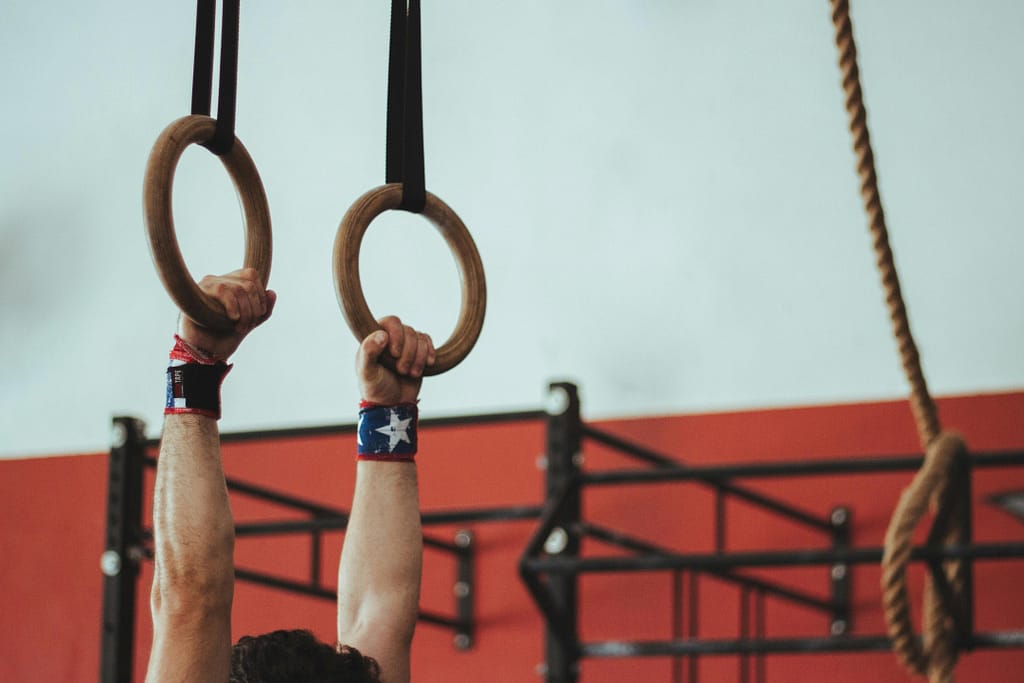
Hanging Find an overhead bar — a pull-up bar at a gym, a doorframe pull-up bar, or a purpose-built hanging bar. Grip the bar with palms facing forward (not in the chin-up position, which does not stretch the CA arch effectively). Allow your body weight to hang, relaxing everything except the hands and fingers.
Start with partial hanging: keep your feet lightly on the floor and gradually allow more of your body weight to be taken by the arms. This is the appropriate starting point for most people with significant shoulder pain.
Each hanging session takes 10–15 minutes in total, during which you hang for intervals of 10–30 seconds with rest breaks in between. Sessions can be daily or near-daily.
The first sessions will probably hurt. This is expected and is not a sign that the exercise is harmful — it is the CA arch being stretched, which is exactly what needs to happen. Kirsch describes this as the paradox of the exercise: the pain experienced while hanging will not injure the shoulder, but must be accepted to overcome the contracture.
Within days to weeks, the pain during hanging typically reduces significantly. Range of motion begins to improve. Night pain often decreases before daytime pain does.
Weight Lifting Performed immediately after hanging — when the CA arch is at its most stretched and the subacromial space is at its most open — the weight lifting component strengthens the rotator cuff and surrounding muscles, rebuilding the active stability that the hanging restores passively.
Starting weights are 1–2 kilograms. The exercises are:
- Forward raises: arm raised straight in front, palms down, to full overhead elevation
- Lateral raises: arm raised to the side, palms down, to full overhead elevation
- Extension raises: arms taken back and upward into extension, as high as possible, palms down
The goal is 30–45 repetitions per movement before increasing weight. Progress is slow and deliberate. The program requires only 15–20 minutes per day — and once symptom resolution is achieved, 2–3 times per week is enough to maintain the gains.
Where Personal Training Comes In
The hanging protocol is simple to describe but not always simple to execute — particularly for people who are already in significant pain, who have limited overhead mobility to start with, or who don’t have the postural foundation to load the shoulder safely.
This is where working with a personal trainer who understands the shoulder — and who understands this protocol specifically — makes a significant difference.
At Advanced Health in Preston, our personal training team can:
Assess your starting point accurately. Not everyone is ready to start with full or even partial hanging. For some people, preliminary work on scapular stability, thoracic spine mobility, and rotator cuff activation is needed before the shoulder can tolerate overhead load safely. A trainer who understands shoulder mechanics can assess this and sequence the program appropriately.
Modify the protocol for your level. There are multiple ways to introduce overhead loading progressively, and the right approach depends on your diagnosis, your pain levels, your current range of motion, and your strength. A skilled personal trainer will design a program that begins where you actually are — not where a textbook assumes you are.
Coach technique. The palm-down grip, the relaxation of the body during hanging, the full elevation of the arm during weight lifting — these technical details matter. Done correctly, they produce the subacromial space expansion the protocol is designed to achieve. Done incorrectly, they can perpetuate the impingement rather than resolve it.
Track progress and adjust. Recovery from shoulder impingement is not linear. There will be better weeks and harder weeks, particularly in the early stages. Having a trainer who can adjust the load, the frequency, and the exercise selection in response to how you’re progressing makes the process more efficient and more sustainable.
Combine the protocol with broader conditioning. For many people, shoulder pain doesn’t develop in isolation. It develops in the context of poor overall postural conditioning, thoracic stiffness, weak scapular stabilisers, and a sedentary lifestyle. A comprehensive personal training program addresses the shoulder within the context of overall movement health — which produces more durable results than the shoulder protocol alone.

The Role of Chiropractic and Remedial Massage Alongside the Hanging Protocol
For people in Preston and Thornbury working through shoulder rehabilitation, the hanging protocol works best when it’s supported by appropriate manual therapy.
Chiropractic care addresses the structural contributors that the hanging protocol alone cannot reach: thoracic spine stiffness that limits full overhead elevation, cervical spine dysfunction that contributes to referred shoulder pain, first rib dysfunction that compresses the brachial plexus, and glenohumeral joint restriction that must be mobilised before full hanging can be achieved.
Remedial massage addresses the muscular component: the chronically tight pectorals, the guarded subscapularis, the trigger points in the infraspinatus that refer pain to the front of the shoulder, and the pervasive upper trapezius tension that elevates the shoulder girdle and reduces subacromial space. Releasing these muscles makes the hanging exercise more comfortable, more accessible, and more effective.
At Advanced Health, our chiropractors and remedial massage therapists in Preston work alongside our personal trainers to provide a genuinely integrated approach to shoulder rehabilitation. The goal is not just symptom relief — it’s restoring the shoulder to the level of function it was designed for, and equipping you with the knowledge, habits, and physical capacity to maintain that function for life.
You Don’t Have to Just Live With It
Shoulder pain has a way of becoming normalised. People put up with it for so long — adjusting how they sleep, how they reach, how they move — that they start to think of it as just part of life. It’s not.
Whether you’ve been diagnosed with subacromial impingement, a rotator cuff tear, frozen shoulder, or just know that something isn’t right but haven’t had it properly assessed — there is almost certainly more that can be done. And most of it doesn’t involve surgery.
At Advanced Health, we offer 14 years of experience helping people in Preston, Thornbury, Reservoir, and across Melbourne’s north get their shoulders back. We take long appointment times — 30 to 45 minutes — because that’s what it takes to understand what’s actually driving your pain. And we combine chiropractic care, remedial massage, and personal training because that combination consistently produces better results than any single approach on its own.
Book your appointment today at advanced-health.com.au or call (03) 9484 9185.
4/107 Plenty Road, Preston VIC 3072 Open 7 days: Mon–Fri 8am–9pm | Sat 7:30am–6pm | Sun 9am–6pm
Private health fund rebates available via on-site HICAPS.
This article draws on the research of Dr John M. Kirsch, MD, published in “Shoulder Pain? The Solution & Prevention” (4th Edition, Bookstand Publishing, 2013). The Kirsch Institute for Shoulder Research was established in 2010. Individual conditions vary — please consult a qualified health practitioner before commencing any exercise program for shoulder rehabilitation.