There’s a good chance you’ve felt it today. That dull, persistent ache at the base of your skull. The tightness across the tops of your shoulders that never quite releases, no matter how often you roll them. The headache that starts behind your eyes around mid-afternoon, just in time to make the drive home from work something to endure rather than enjoy.
You might have put it down to stress, or dehydration, or just the cost of sitting at a desk. But there’s a more specific, and more correctable, explanation — and it has everything to do with the position your head has been spending most of its waking hours in.
In 2025, the Chiropractors Association of Australia made a term most people had never heard of the national focus of Spinal Health Week: tech neck. Their data, compiled from clinics across the country, told a sobering story. Over 5.3 million Australians are currently suffering from neck pain and spinal problems linked directly to screen use. The economic cost — in lost productivity, absenteeism, and healthcare spending — has been estimated at $55 billion per year. And the condition is spreading rapidly into groups that previously didn’t see chiropractors: teenagers, children, young adults in their twenties.
The ACA called it a time bomb. We think that’s about right.
What Is Tech Neck — And Why Is It Happening Now?
Tech neck, or tension neck syndrome, is the cluster of symptoms that develops when the head is held in a sustained forward position relative to the spine — most commonly while looking at a phone, a laptop screen, or a monitor positioned too low.
To understand why this matters, it helps to understand what’s happening in your spine when your head moves forward.
The average human head weighs between 4.5 and 5.5 kilograms. When it sits directly over the spine — with your ears roughly in line with your shoulders — the load on the cervical vertebrae is exactly what it should be: manageable, distributed, sustainable. But as the head tilts forward, the effective load on the neck increases dramatically. At 15 degrees of forward tilt, the load on the cervical spine is roughly 12 kilograms. At 30 degrees, it becomes 18 kilograms. At 45 degrees — the angle at which most people look at their phones — it reaches approximately 22 kilograms. At 60 degrees, the most extreme end of the range, the force climbs to over 27 kilograms.
That is the equivalent of carrying a small child on your neck. For hours. Every day.
The human spine was not designed for this. It evolved for movement, for variation, for the kind of mixed postures that came with walking, climbing, reaching, carrying, and rest. It did not evolve for sustained static loading in a single forward-flexed position, day after day, year after year. And the tissues of the cervical spine — the muscles, the intervertebral discs, the facet joints, the ligaments — respond to that loading exactly as you’d expect them to: they adapt, and not in a good way.
What Tech Neck Actually Does to Your Neck
The changes that develop in a chronically forward-loaded cervical spine are progressive, predictable, and — if caught early enough — largely reversible. Here’s what happens at each stage.
Stage 1 — Muscle fatigue and tension. The muscles at the back of the neck (particularly the suboccipital group at the base of the skull, and the levator scapulae and upper trapezius that run into the shoulders) are working constantly and asymmetrically to support the extra load. They fatigue. They develop trigger points — localised bands of hypercontracted muscle fibre that are exquisitely tender to palpation and that refer pain into the head, behind the eyes, and down into the shoulder blades. This is the stage at which most people first notice something is wrong: a persistent tension headache or a shoulder that refuses to relax.
Stage 2 — Altered joint mechanics. As the forward head posture becomes habitual, the joints of the cervical spine adapt to the new position. The facet joints — small paired joints at the back of each vertebra — begin to bear load differently. Some become compressed and restricted; others become hypermobile in compensation. The normal lordotic curve of the neck (the gentle backward curve that gives it both its strength and its shock-absorbing capacity) progressively flattens. The discs between the vertebrae, no longer loaded evenly, begin to show asymmetric wear.
Stage 3 — Neural irritation. As joint mechanics deteriorate and muscles develop trigger points, the nerve roots that exit the cervical spine can become irritated. This produces the radiating symptoms that bring patients into our clinic in Preston genuinely alarmed: tingling down the arm, numbness in the fingers, weakness in the grip, or a shooting pain that runs from the neck into the elbow or wrist. Left unaddressed, cervical nerve irritation can become a chronic condition that significantly limits daily function.
Stage 4 — Structural change. Over years, the combination of abnormal loading, altered joint mechanics, and disc stress can produce lasting structural changes: degenerative disc disease, foraminal narrowing, bone spur formation. These findings, when they appear on MRI or CT, often alarm patients. But it’s important to know that structural changes visible on imaging do not automatically determine your long-term outcome — and they very rarely require surgery. What they do require is proper treatment and a commitment to changing the habits that produced them.

Who’s Most at Risk?
The ACA’s 2025 data offered some striking demographic specifics that are worth understanding, because tech neck doesn’t affect everyone equally.
Women are more affected than men — particularly women aged 31 to 40, who reported the highest rates of neck symptoms. This likely reflects a combination of occupational patterns, the tendency toward smaller, lower-positioned laptop screens, and differences in neck musculature and biomechanics.
But the fastest-growing demographic is considerably younger. Chiropractors across Australia reported a sharp rise in presentations from teenagers and children — many of whom are experiencing significant neck symptoms before the age of 18. This is a development without real historical precedent. The cervical spine is still developing during adolescence; sustained abnormal loading during this period creates a very different risk profile than the same loading in an adult.
In Melbourne’s northern suburbs — where a high proportion of residents commute to CBD office jobs, work from home in improvised desk setups, and spend significant time looking at devices during long commutes on the Upfield and Hurstbridge lines — we see the full demographic range. Desk workers, students, tradies who spend hours looking down at workbench level, parents who carry infants on one side for years. The posture risk is everywhere.
Why Most People Don’t Get Better on Their Own
The most common thing people try first when they develop tech neck symptoms is some combination of rest, heat, over-the-counter pain relief, and stretching they found on YouTube. These approaches are not without value — but they consistently fail to produce lasting relief, and it’s worth understanding why.
Rest and heat address the symptom — the tight, aching muscles — without addressing the cause: the altered joint mechanics and postural habits that are producing the muscle tension in the first place. The muscles are tight because the joints they’re protecting are under abnormal load. Release the muscles through massage or heat, and they’ll feel better for a day or two. But the underlying mechanical problem hasn’t changed, and the muscles return to exactly the same state.
Similarly, stretching the neck muscles — while beneficial in isolation — doesn’t restore joint mobility. Cervical facet joints that have become restricted need direct mobilisation or manipulation to restore their normal movement. No amount of stretching achieves this. It’s a different tissue, and it requires a different intervention.
The other thing that self-management consistently fails to address is the postural pattern itself. Most people don’t know what they look like when they work. They don’t know where their screen is positioned relative to their eye line, how far forward their head drifts over the course of a working day, or what specific changes to their environment would meaningfully reduce the load on their cervical spine. This is information that requires an assessment, not a YouTube video.
How Chiropractic and Remedial Massage Treat Tech Neck
At Advanced Health in Preston, our approach to tech neck combines hands-on treatment with education and postural retraining — because addressing the symptom without addressing the cause is only ever half the job.
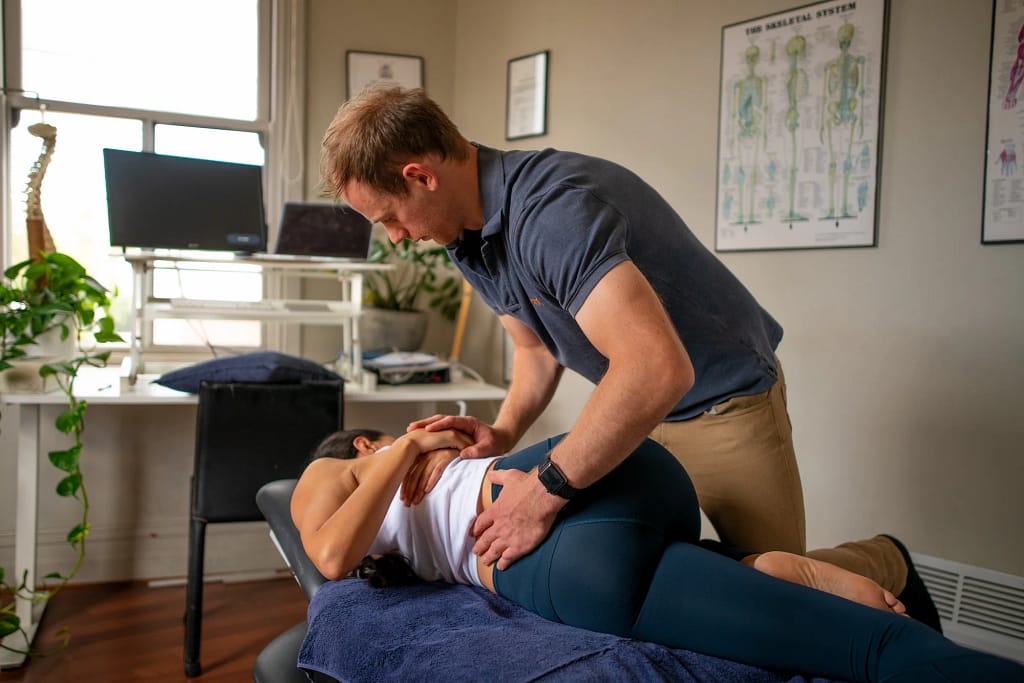
Chiropractic assessment and cervical adjustment. A thorough chiropractic assessment establishes exactly which segments of the cervical and upper thoracic spine are restricted, which are hypermobile in compensation, and how the whole mechanical picture fits together. Targeted spinal manipulation to the restricted segments restores joint mobility, reduces mechanical load on the surrounding muscles and discs, and often produces immediate relief from headache and referred arm symptoms. The thoracic spine — the mid-back — plays a critical and often overlooked role in neck mechanics: a stiff thoracic spine forces the cervical spine to compensate, and restoring thoracic mobility is a central part of treating any sustained-posture neck condition.
Remedial massage for trigger point release. The trigger points that develop in the suboccipital, levator scapulae, and upper trapezius muscles are a primary driver of the headaches and shoulder pain that accompany tech neck. Skilled remedial massage targets these points directly, using a combination of ischaemic compression, myofascial release, and deep tissue techniques to deactivate them and restore normal muscle length and function. Many patients notice the most dramatic headache relief from this component of treatment.
Postural retraining and ergonomic advice. This is where the long-term work happens. We’ll review your workstation setup, identify the postural habits that are loading your neck, and give you a specific set of exercises designed to retrain the deep cervical flexor muscles — the muscles that should be maintaining your head position but have been progressively weakened by years of forward head carriage. These exercises, performed consistently, are the difference between treatment that holds and treatment that needs repeating indefinitely.
Home programme. Simple daily interventions — a chin tuck exercise performed at your desk, a thoracic extension stretch over the back of a chair, screen height adjustments — can dramatically reduce the cumulative load on the cervical spine over the course of a working day. We’ll make sure you leave each appointment with a clear, practical understanding of what to do at home.
When to Seek Help
If you’re experiencing persistent neck pain, headaches that recur more than two or three times per week, or any tingling, numbness, or weakness in the arms or hands, these are symptoms that warrant a proper assessment rather than continued self-management.
The earlier tech neck is addressed, the more straightforwardly it resolves. The changes that occur in the cervical spine in the early stages — muscle tension, minor joint restriction, early postural adaptation — respond quickly to appropriate treatment. The changes that occur after years of progression — disc degeneration, chronic neural irritation, structural adaptation — take longer and require more consistent care.
The good news is that even long-standing tech neck presentations respond to treatment. We regularly see patients who have had daily headaches for years, who had accepted neck pain as simply a feature of their working life, achieve significant and lasting improvement within a few weeks of starting care. The spine is more adaptable than most people believe — it just needs to be pointed in the right direction.
We’re Here When You’re Ready
If you’re in Preston, Thornbury, Reservoir, Northcote, or anywhere in Melbourne’s north and your neck has been causing you grief, we’d genuinely love to help.
At Advanced Health, our chiropractors and remedial massage therapists work together to give you a complete picture of what’s happening in your neck and a practical plan to fix it. We’re not interested in indefinite passive treatment — we’re interested in getting you better and keeping you that way.
Book an appointment at advanced-health.com.au or call us on (03) 9484 9185.
We’re open 7 days — weekdays from 8am to 9pm, Saturdays from 7:30am, and Sundays from 9am. Plenty of parking on Plenty Rd.
4/107 Plenty Road, Preston VIC 3072
This post is for educational purposes. Data on tech neck prevalence and economic impact cited from the Chiropractors Association of Australia’s Spinal Health Week 2025 media release. If you’re experiencing progressive neurological symptoms — significant arm weakness, loss of hand function, or any bladder or bowel changes — please seek urgent medical attention.