The common search “massage Thornbury” often leads to a very practical question: what should you wear? The short answer is comfortable clothing that is easy to move in. You do not need to buy anything special, and you should not feel obliged to undress beyond your comfort level.
What matters more is a clear conversation before treatment. The therapist needs to understand why you booked, what feels different, which activities are affected and whether anything in your health history changes what is appropriate. Clothing, positioning and draping can then be agreed with you—not assumed.
Advanced Health provides remedial massage at its Preston clinic, close to Thornbury. This guide explains how to arrive prepared while keeping the appointment comfortable, useful and firmly within your control.
The simplest clothing choice
Wear loose, clean clothes that let you sit, stand and move without restriction. A T-shirt or singlet with shorts, track pants or flexible exercise clothes usually works well. If your concern involves a knee, calf or shoulder, clothing that allows easy access to that area can make assessment simpler.
Avoid choosing an outfit that makes you worried about stretching the fabric, creasing work clothes or getting massage oil on a favourite item. Heavy belts, large jewellery and several tight layers can also be inconvenient. You can bring a change of clothes if you are coming straight from work.
You may be asked whether you are comfortable changing for hands-on treatment. That is a choice, not a requirement to ignore your preferences. Ask what access is needed and why. If you want to remain more covered, say so; the therapist can discuss clothing-on techniques, different positioning or a change to the treatment plan.
What to bring to the first appointment
- A short description of the problem: when it began, what makes it better or worse, and the movement or activity you want to manage more comfortably.
- Relevant health information: medicines, allergies, recent surgery or injury, pregnancy, skin changes and any condition that may affect treatment.
- Reports only when relevant: you do not need to collect scans for a routine visit, but bring an existing report if another practitioner has asked you to share it.
- Your practical questions: fees, private health claiming, parking and appointment length are easier to settle before treatment starts.
Arriving a few minutes early can give you time to complete any new-patient paperwork without cutting into the discussion.
Expect questions before hands-on care
Healthdirect’s massage therapy guidance notes that a therapist may ask about your medical history, symptoms and the result you want from the session. Give a straightforward account rather than trying to supply your own diagnosis. “My shoulder aches when I reach overhead” is more useful than guessing which tissue is responsible.
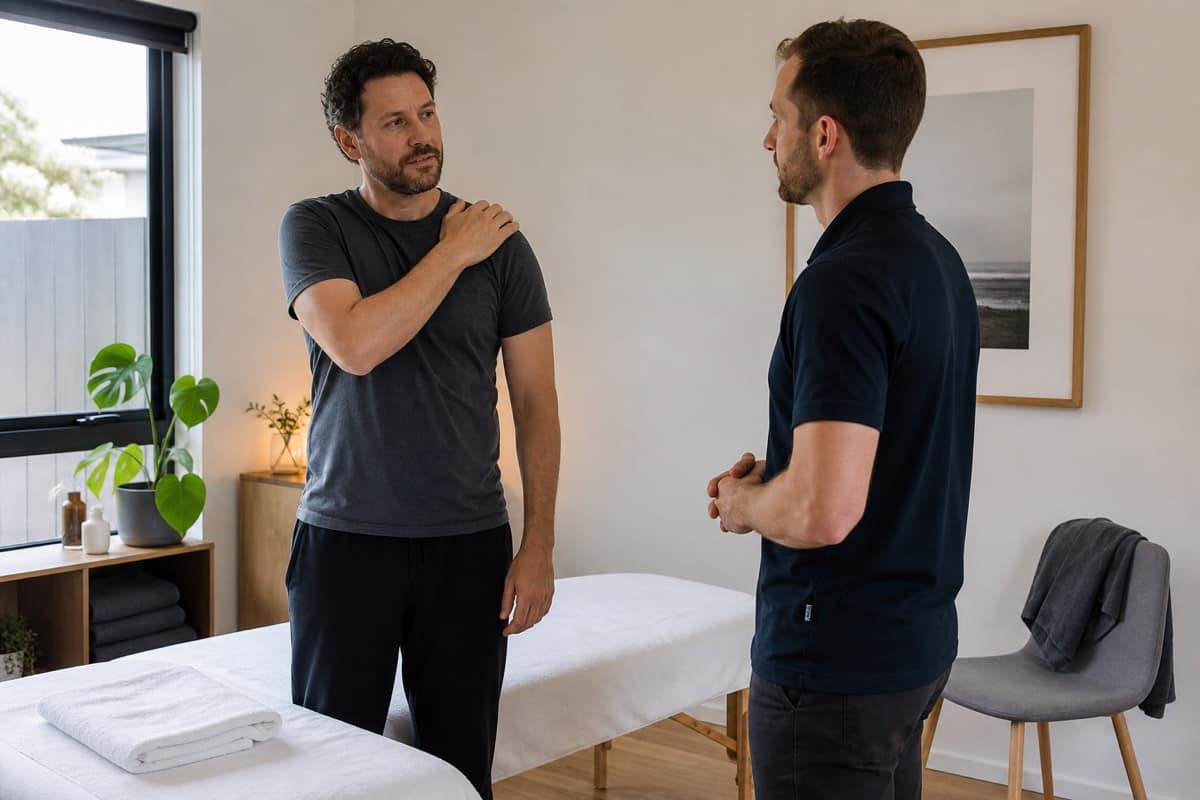
Consent is an ongoing conversation. The Australian Commission on Safety and Quality in Health Care describes informed consent as a voluntary decision made after receiving relevant information. In practice, you can ask what the therapist proposes, what you may feel, what alternatives exist and whether the plan can be changed.
Privacy, draping and positioning
The therapist should leave the room while you change and provide a sheet or towel for coverage. Only the area being treated should be uncovered. If lying face down is uncomfortable, mention it. Side-lying, face-up or seated positions may be possible depending on the treatment and your needs.
You can ask to keep an area covered, request a different position, reduce the pressure or stop at any time. A strong sensation is not proof that treatment is working. Pressure should remain within an agreed, tolerable range, and sharp pain, numbness, tingling, dizziness or feeling unwell should be reported immediately.
Food, exercise and timing
There is no special pre-massage diet. A very large meal immediately beforehand may make lying down uncomfortable, while arriving hungry or dehydrated may leave you distracted. Eat and drink normally, allowing enough time for your own comfort.
If you plan hard training on the same day, tell the therapist what the session involves. The appointment can be discussed in that context rather than treated as a generic recovery ritual. Also mention a recent collision, fall, strain or sudden change in symptoms before any hands-on work begins.
When to postpone massage and seek advice
Contact the clinic before attending if you have a fever, contagious illness, a new skin infection or an open wound near the planned treatment area. Seek medical advice first for severe or rapidly worsening pain, major swelling, unexplained bruising, symptoms after a significant injury, or new weakness, numbness or loss of coordination.
Call Triple Zero (000) for an emergency such as chest pain, difficulty breathing, sudden loss of movement or feeling, or a serious accident. Massage is not a substitute for urgent assessment in these situations.
Getting from Thornbury to the Preston clinic
The Preston clinic is at 4/107 Plenty Road, accessible from Thornbury along the Route 86 tram corridor. Allow a little travel time so you can start the appointment settled rather than rushed.
If you are unsure whether massage suits your situation, contact the clinic before booking. You may also find the guide to choosing a remedial massage provider near Preston useful. When you are ready, appointments are available through the online booking page.
Frequently asked questions
Do I have to take off all my clothes for remedial massage?
No. Discuss what the therapist needs to assess or treat and what you are comfortable with. You can keep more clothing on, ask for an area to remain covered or decline part of a proposed treatment.
Should I wear shorts?
Shorts can be convenient for a leg or hip concern, but they are not essential. Flexible track pants or exercise clothes may also work. Bring a change of clothes if that makes the visit easier.
Can I go to a massage appointment straight from work?
Yes. Arrive in clean clothing and bring something comfortable to change into if your workwear is restrictive. Tell the therapist about physical tasks, prolonged sitting or anything else at work that relates to the concern.
This article provides general information only. It does not diagnose a condition or replace individual medical advice. If symptoms are severe, worsening or concerning, seek care from a qualified health professional. In an emergency, call Triple Zero (000).