Your usual walk felt fine, so you added another loop. Now the first steps out of bed feel stiff at the back of your heel. It is tempting to book a calf massage and carry on with the longer route.
Before doing that, it helps to ask what has changed: the distance, the hills, the pace, or your ability to recover between walks. Remedial massage may have a place in a broader plan, but persistent Achilles pain needs assessment rather than an assumption that the calf simply needs loosening.
Why the location and timing matter
The Achilles tendon connects your calf muscles to your heel. Soreness where it attaches to the heel is a different presentation from soreness further up the tendon. Neither can be diagnosed from a description alone.
Achilles tendinopathy can involve stiffness after rest and discomfort that eases during movement, then returns afterwards. Feeling better halfway through a walk does not necessarily mean that distance suits you. The Royal National Orthopaedic Hospital’s patient guide explains these patterns and why treatment needs to reflect the tendon’s location and sensitivity.
For a walker in Preston, the useful detail might be that the flat trip to the shops is comfortable but the longer weekend route leaves a lingering ache. Tell the practitioner about that difference. “It hurts after walking” gives much less information.
What an assessment should work out
A clinician needs to connect your symptoms with what the leg can currently manage. Useful questions include:
- Did the pain build gradually, or begin with a sudden push-off, trip or pop?
- Is it at the heel, along the tendon, or mainly in the calf?
- Have you recently added distance, speed, hills, stairs or more days on your feet?
- Are you limping, losing strength or finding ordinary daily tasks harder?
- Have footwear, health conditions, medicines or previous injuries changed the picture?
Depending on the findings, assessment may include walking, ankle movement, calf strength and balance. A sudden injury needs a different pathway from gradual soreness. Imaging is not automatic; a suitably qualified clinician can decide whether uncertainty, suspected tearing or an unexpected course makes it useful.
Where remedial massage fits
At Advanced Health, a remedial massage appointment in Preston should begin with your symptoms and goals. If calf discomfort or restricted movement is relevant, hands-on treatment may be considered after assessment, with pressure adjusted to your tolerance.
The 2024 Achilles clinical practice guideline recommends tendon-loading exercise as a first-line treatment for appropriate midportion tendinopathy presentations. Its recommendation for manual therapy is based on expert opinion, with limited research. Massage should therefore not be presented as a way to repair the tendon or replace rehabilitation.
Agree on what the session is trying to achieve and how you will judge its value. Feeling looser immediately afterwards is only one observation; walking tolerance and the next morning’s symptoms also matter. A therapist may recommend another practitioner for assessment or rehabilitation beyond their scope.
Adjust the walk before adding more
If symptoms are mild and gradual, and none of the warning signs below apply, consider a shorter, flatter outing at a comfortable pace. Leave the extra loop for later. Choose shoes that feel comfortable and avoid pressure over the sore area; no particular brand suits everyone.
These are adjustable options, not a required walking prescription. Guy’s and St Thomas’ guidance describes reducing aggravating time on your feet while maintaining other tolerable activity.
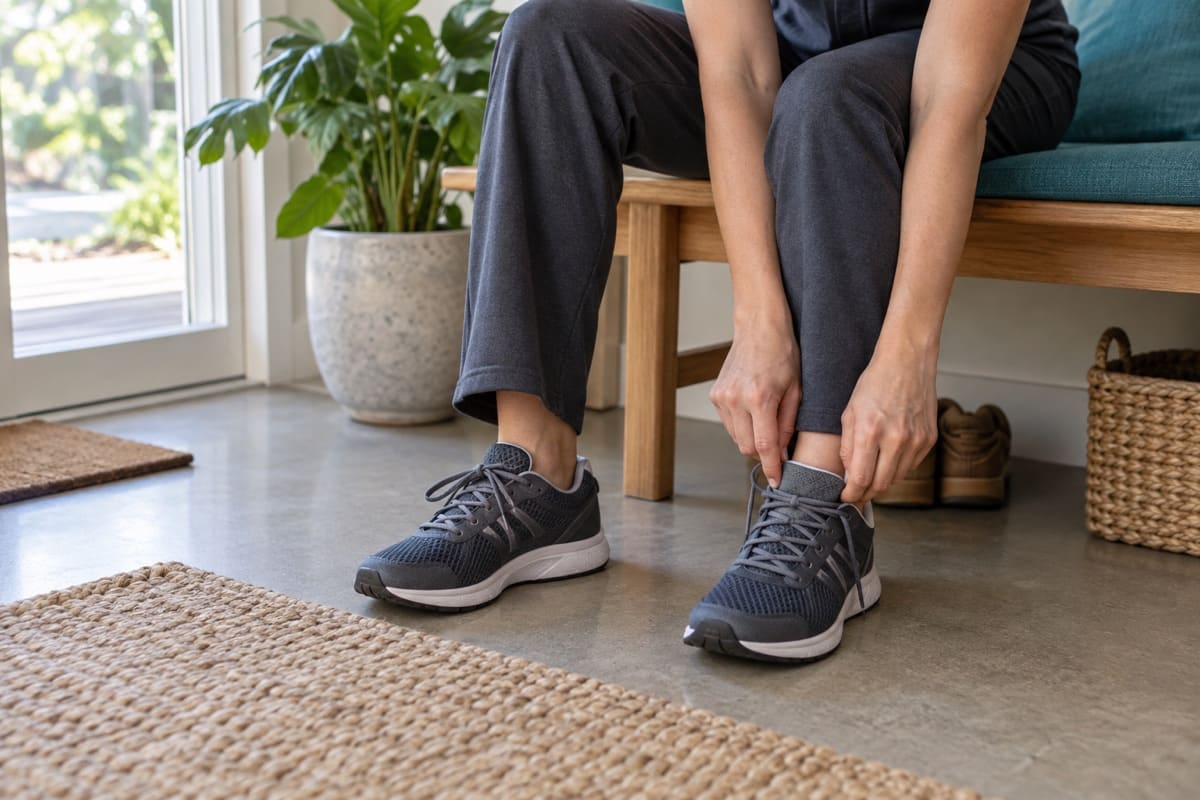
Notice three things: how you walk during the outing, whether soreness settles afterwards, and whether morning stiffness is increasing. If you start limping, develop sharp or escalating pain, or remain noticeably worse the following day, reduce the provoking activity and seek advice. Do not repeatedly test a painful heel with a long walk.
When symptoms and everyday function are stable, change one demand at a time. For example, discuss increasing distance before adding faster walking or hills. A simple note of the route and your response can make the next appointment more useful. This approach is consistent with NHS advice on adjusting walking and monitoring next-day symptoms.
Why there is no universal heel-raise routine
After assessment, rehabilitation might begin with supported calf loading, comfortable ankle movement or balance work. The starting position, range, resistance, repetitions and recovery time depend on your presentation. A clinician may progress from two-leg support towards greater resistance or single-leg demands when control and symptom response allow.
Do not assume that dropping the heel off a step is suitable for every sore Achilles. Pain at the tendon’s attachment can need different range choices. Reduce the range or load if an exercise provokes a sustained flare, and stop for sharp pain, new weakness or altered sensation. Ask for review if function is deteriorating or the plan is not helping.
When to seek medical care first
Seek urgent assessment after a sudden snap or pop, a feeling of being kicked behind the ankle, marked swelling, or new difficulty pushing off or bearing weight. An Achilles rupture can still need urgent care even if the initial pain eases. Avoid massage and stretching while arranging assessment.
A newly swollen, red or warm calf also needs prompt medical assessment, particularly when the swelling is unexplained. Healthdirect advises immediate medical care for possible deep vein thrombosis. Call 000 for chest pain or sudden trouble breathing.
Questions before booking
Can I walk after a massage?
Base the decision on your symptoms and agreed plan. Do not use temporary relief to catch up on missed distance. Our guide to exercise after a massage session explains how to approach the next activity.
Which appointment should I choose?
If the heel pain keeps returning or walking is becoming harder, contact the clinic and describe those changes before choosing a massage-focused visit. You can book online once the appropriate appointment is clear. Bring the shoes you usually walk in and a rough account of your recent walking load.
This article provides general information, not a diagnosis or an individual treatment or exercise plan. Seek advice suited to your symptoms and health history.